Walking through
chemical space.

We develop computational methods for molecular representation, property prediction, and structure generation. Ouroboros is one recent effort within a broader program that also studies protein–ligand interactions and cellular phenotype modeling.

Postdoctoral Researcher
Institute of Systems Medicine
Chinese Academy of Medical Sciences

A shared encoding supports molecular representation, property guidance, and structure generation.

  1. 01 · Encode

    Molecular representation

    A GNN maps molecular graphs to 1D vectors shaped by molecular fingerprint, conformational-space, and pharmacophore similarity.

  2. 02 · Navigate

    Property guidance

    Independent property decoders provide objectives for updating molecular encodings.

  3. 03 · Decode

    Structure generation

    An independent Transformer decodes modified vectors to SMILES for subsequent prioritization and evaluation.

Advanced Science · 2026

Ouroboros

Ouroboros examines how a molecular representation foundation can be extended into a generation engine. A similarity-matrix objective organizes an encoding space informed by molecular fingerprints, conformational space, and pharmacophores; task-specific property decoders and an autoregressive SMILES decoder then support prediction, search, and iterative optimization.

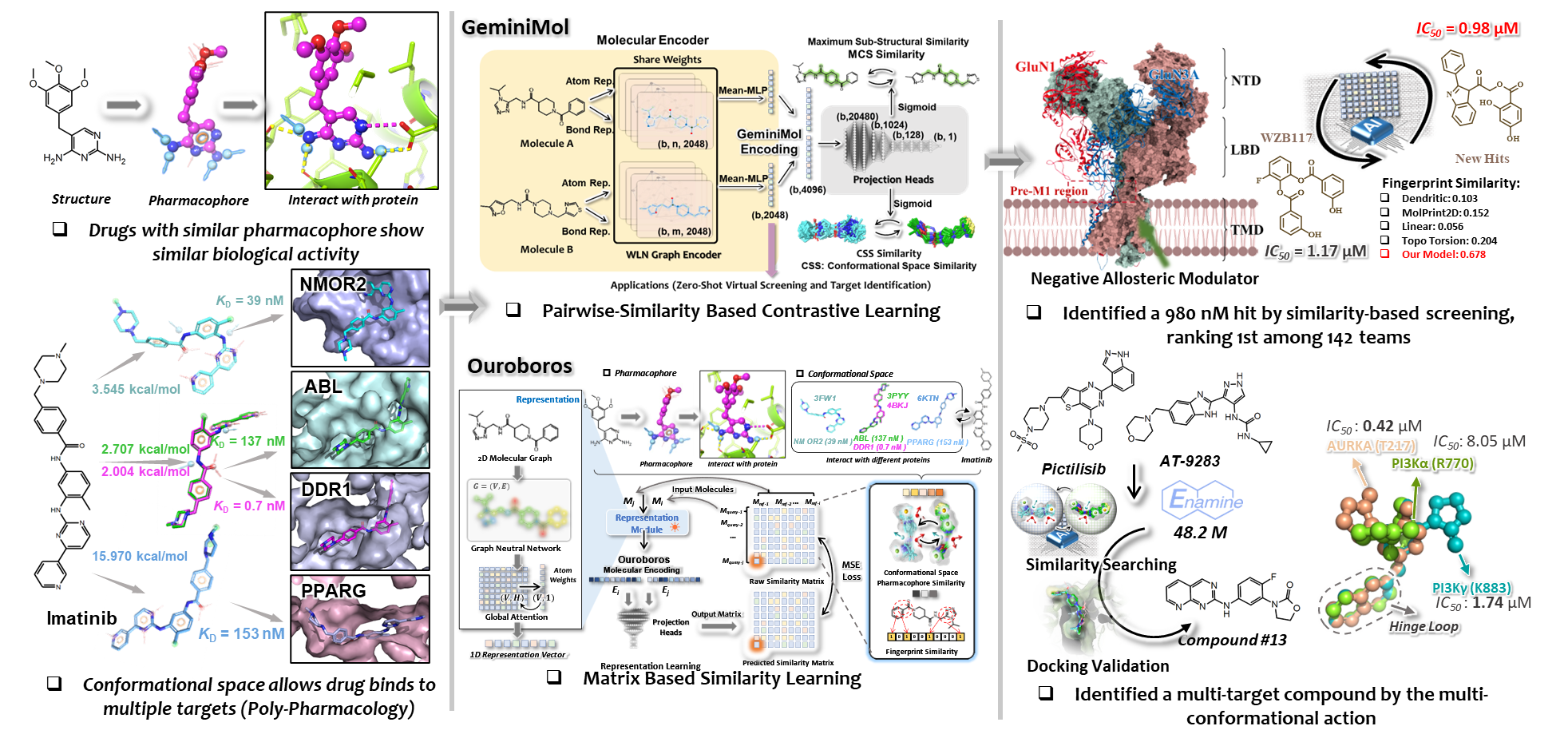
From pairwise similarity to similarity matrices.

GeminiMol and Ouroboros both use conformational-space and pharmacophore similarity as chemical priors. The later model changes how those relationships supervise the representation space.

GeminiMol

Pairwise-similarity contrastive learning

GeminiMol learns from paired molecules, bringing encodings closer when their conformational and pharmacophore profiles are similar.

Validated in similarity search and screening.

Ouroboros

Matrix-similarity contrastive learning

Ouroboros supervises batches with full molecular similarity matrices, allowing multiple relative relationships to organize the encoding space together.

Validated in prediction, guided generation, and molecular discovery.

Composite research figure comparing GeminiMol pairwise-similarity contrastive learning with Ouroboros matrix-similarity learning and representative molecular-screening studies.
Method lineage and representative validation settings. Open the full-resolution figure ↗

01 · Encode

Represent molecular similarity

A global-attention GNN maps each molecular graph to a 2048-dimensional vector. Training against molecular similarity matrices integrates fingerprint, conformational-space, and pharmacophore relationships.

02 · Navigate

Guide changes in the encoding

Relevant property decoders translate encodings into task-specific predictions and provide objectives for navigating the representation space.

03 · Decode

Decode candidate structures

An autoregressive Transformer reconstructs SMILES from input or revised encodings, yielding candidate structures for subsequent prioritization and evaluation.

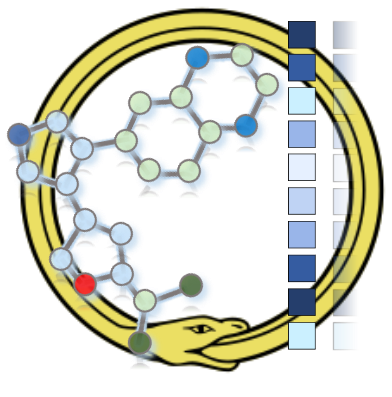
Ouroboros symbol showing a molecular graph enclosed by a serpent beside an ordered molecular representation vector.
The visual mark summarizes a molecular graph mapped to an ordered representation vector.

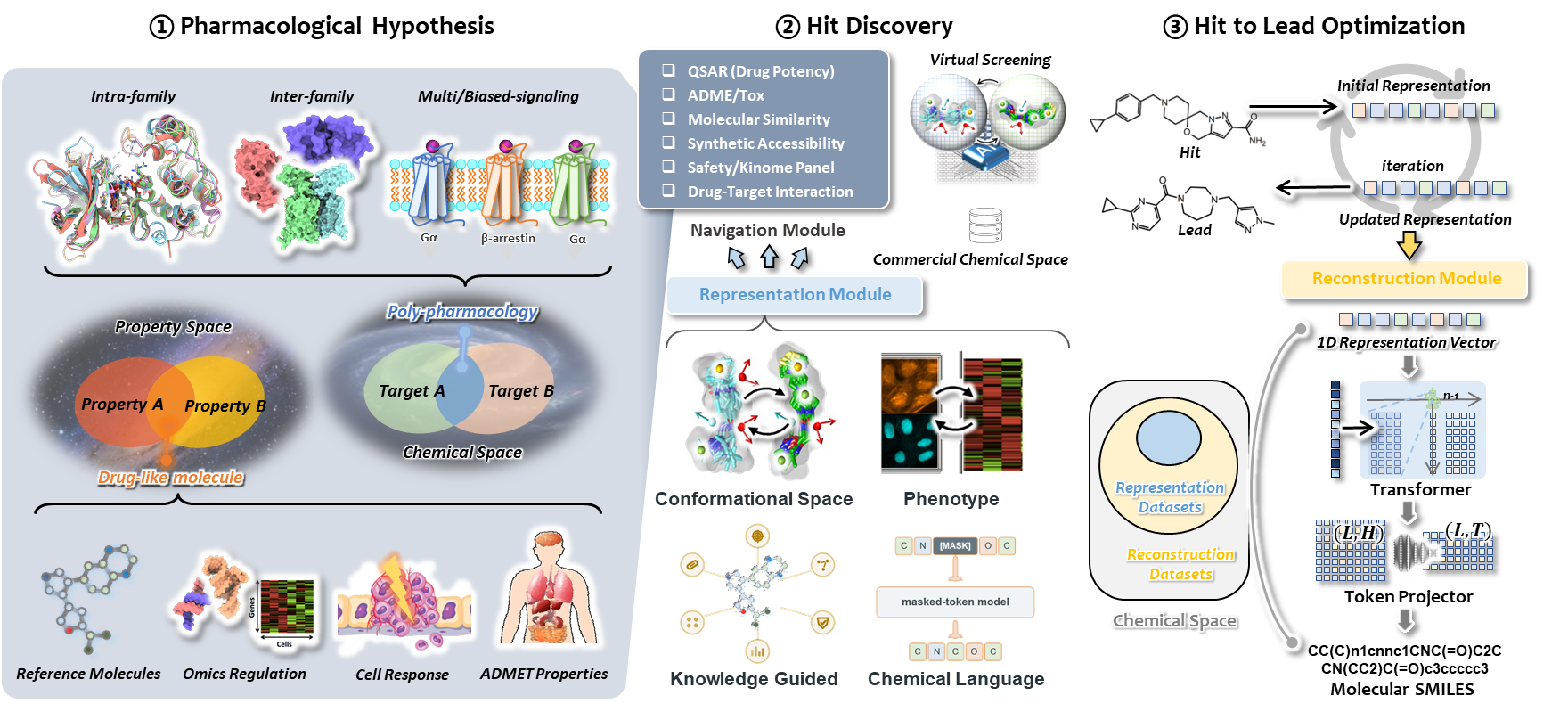
Pharmacological hypotheses become objectives for navigating molecular encodings.

A pharmacological hypothesis defines what the system should optimize. A relevant property decoder turns the representation into a prediction for that objective; its signal guides movement through encoding space, and the SMILES decoder reconstructs revised encodings as candidate structures.

  1. 01

    Pharmacological hypothesis

    A desired profile, reference molecule, phenotype, or target combination.

  2. 02

    Predictive objective

    A property decoder or similarity target expresses the task in the representation space.

  3. 03

    Encoding-space navigation

    Search or iterative updates move molecular vectors toward the objective.

  4. 04

    Structure reconstruction

    The generative decoder returns candidate SMILES for subsequent evaluation.

After a hypothesis defines an objective, the same foundation can support complementary search strategies.

Chemical-space search

For virtual screening or de novo exploration, the objective ranks or guides candidate encodings across a broader chemical space.

Hit-to-lead optimization

Starting from a known hit, its encoding is iteratively updated toward the objective while proximity to the starting molecule can be monitored.

Multi-reference navigation

Several reference sets or objectives can be combined to examine candidates consistent with a multi-target hypothesis.

Ouroboros application framework connecting pharmacological hypotheses with hit discovery and hit-to-lead optimization in molecular representation space.
Application landscape: pharmacological hypotheses define objectives for chemical-space search or iterative optimization from a known hit. Open the full-resolution figure ↗

AI engines for drug discovery.

These projects address molecular representation, phenotype-based screening, protein structure and interactions, and synthetic accessibility. Together they provide context for the development of Ouroboros.

2024

Molecular representation

GeminiMol

Conformational-space profiling for general molecular representation.

Hybrid contrastive learning informed by conformational and pharmacophore similarity across distinct molecular scaffolds.

2025

Multimodal phenotype

PhenoModel

Aligning molecular graphs with cellular morphology.

A foundation model aligning molecular graphs with cell images for phenotypic virtual screening.

2026

Protein conformations

ProteinConformers

Evaluating simulated protein conformational landscapes.

A benchmark for the diversity and plausibility of simulated protein conformational landscapes.

2022

Protein interactions

PPI-Miner

Combining structural and sequence motifs for protein-interaction analysis.

A co-driven computational method for PPI discovery, interaction modeling, and molecular-glue research.

2023

Synthetic accessibility

DeepSA

Predicting synthetic accessibility for molecular design.

A deep-learning model for identifying compounds likely to be difficult to synthesize.

Open tools for everyday research.

Alongside published studies, we maintain practical tools that support database searching, molecular simulation, and reproducible computer-aided drug-design workflows.

01 · Database navigation

Biodb-Search

A browser-based navigator that sends one query to multiple biomedical databases, designed to make routine literature and data lookup more direct.

02 · Molecular dynamics

AutoMD / AutoTRJ

Automation for Desmond system setup and molecular-dynamics simulation, paired with a configurable pipeline for trajectory processing and analysis.

03 · CADD workflows

CADD-Scripts

Shell utilities for virtual screening, cross-docking, and protein modeling with Schrödinger and Rosetta, shared to support reproducible computational workflows.

Recent publications

The full record contains 33 publications and book chapters from 2020–2026.

Loading publication record…

View all publications

News

An archive of research releases, competition results, community tools, and publication milestones from the earlier site.

  1. The Ouroboros study, Learned Conformational Space and Pharmacophore Into Molecular Foundational Model, was published in Advanced Science.

  2. The PhenoModel study on multimodal phenotypic drug design was published in Acta Pharmaceutica Sinica B.

  3. We introduced PhenoScreen, a dual-space contrastive learning framework combining conformational-space and molecular-image similarities for virtual screening.

  4. Using GeminiMol, we identified an inhibitor of GluN1/GluN3A (IC50 = 0.98 μM); the work received first prize in the 2023 Shanghai International Computational Biology Innovation Competition.

  5. The GeminiMol paper was published in Advanced Science.

  6. We introduced GeminiMol, which incorporates conformational-space information into molecular representation learning; see the code and bioRxiv preprint.

  7. DeepSA was published in the Journal of Cheminformatics; the DeepSA web server is also available.

  8. Together with Shihang Wang, we developed DeepSA, a sensitive model for assessing the synthetic accessibility of small molecules.

  9. We expanded the original plmd script and renamed it AutoMD, adding support for more force fields and customizable trajectory-analysis pipelines.

  10. We developed the motif-driven PPI-Miner method. The study appeared in the Journal of Chemical Information and Modeling, with source code on GitHub.

  11. We released a database of potential CRBN substrates, covering human proteins with a β-hairpin loop and a surface complementary to CRBN.

  12. We identified an allosteric pocket on the SARS-CoV-2 spike protein and designed inhibitors intended to restrict its conformational change; the study was published in the Journal of Medicinal Chemistry.

  13. We reported five candidate small-molecule antiviral blockers targeting the SARS-CoV-2 spike protein in Acta Pharmacologica Sinica.

  14. We released automated Schrödinger workflows for cross-docking (XDock), virtual screening (GVSrun), and molecular-dynamics simulation (plmd), with the source code on GitHub.

  15. We released Biodb-Search, a user-friendly biomedical database navigator intended to make literature research more efficient.

  16. We released GetPDB, an automated script for downloading single-chain protein structures by UniProt ID.

Training and current research.

Research training has progressed from life science and structural modeling to molecular, protein, and multimodal machine learning.

  1. 2019

    B.S. in Life Science

    Northeast Agricultural University

    Biological foundations and early computational drug-discovery workflows.

  2. 2020–2024

    Ph.D.

    ShanghaiTech University

    Structural biology, molecular dynamics, protein interactions, and physically informed molecular representation.

  3. Current

    Postdoctoral Researcher

    Institute of Systems Medicine, CAMS

    Molecular and protein foundation models, phenotype-based learning, and translational drug-discovery applications.

Research interests and collaboration.

We welcome discussions with researchers working across molecular modeling, machine learning, and experimental drug discovery.

Wanglin1102@outlook.com